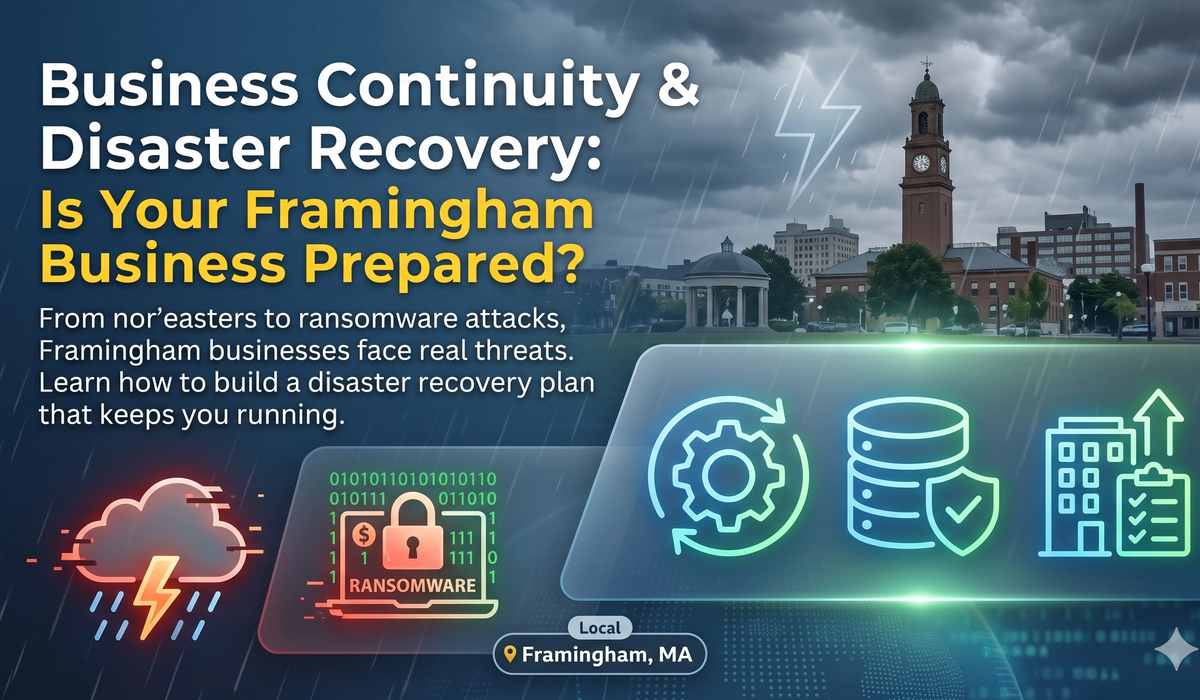
Business Continuity & Disaster Recovery: Is Your Framingham Business Prepared?
From nor'easters to ransomware attacks, Framingham businesses face real threats. Learn how to build a disaster recovery plan that keeps you running.
Disasters Don't Wait for a Convenient Time
Whether it's a New England ice storm knocking out power, a ransomware attack encrypting your files, or a burst pipe flooding your server room — disasters happen. The question isn't *if* but *when*.
60% of small businesses that lose their data close within 6 months. A solid business continuity and disaster recovery (BCDR) plan is your insurance policy against catastrophe.
What Is Business Continuity vs. Disaster Recovery?
Business Continuity (BC) is the big picture — how does your entire business keep operating during and after a disruption? This includes communication plans, alternative work locations, and manual processes for critical functions.
Disaster Recovery (DR) is the IT-specific component — how do you restore your technology systems, data, and connectivity after an outage?
Both are essential. Together, they form your BCDR plan.
Building Your BCDR Plan
Step 1: Business Impact Analysis Identify your critical systems and data. How long can you operate without email? Your accounting system? Your phone lines? This determines your Recovery Time Objective (RTO) and Recovery Point Objective (RPO).
Step 2: Risk Assessment What threats are most likely in the MetroWest area? Power outages from storms, hardware failures, cyber attacks, and human error top the list for most local businesses.
Step 3: Backup Strategy Follow the 3-2-1 rule: 3 copies of your data, on 2 different types of media, with 1 stored offsite (cloud). Ensure backups run automatically and are tested monthly.
Step 4: Recovery Procedures Document step-by-step procedures for restoring each critical system. Who is responsible? What are the credentials? Where are the recovery media stored?
Step 5: Communication Plan How will you notify employees, clients, and vendors during an outage? Have backup communication channels (cell phones, personal email) documented and accessible.
Step 6: Test Annually A plan that's never tested is just a document. Run tabletop exercises and actual recovery tests at least once a year.
Local Risks for Framingham Businesses
MetroWest businesses face some region-specific risks worth considering:
- Winter storms — Heavy snow and ice can cause multi-day power outages.
- Aging infrastructure — Many office buildings along Route 9 and Route 30 have older electrical and network wiring.
- Construction disruption — Ongoing development in downtown Framingham occasionally impacts utilities.
Get a Free BCDR Assessment
Pro Tech Guy helps businesses across Framingham, Natick, Marlborough, and the MetroWest region build and test disaster recovery plans. We'll evaluate your current backup systems, identify gaps, and build a plan that fits your budget and risk tolerance.